
Table of Contents
Introduction
City Palace Jaipur is one of the most exemplary representations of Rajasthan’s royal past and architectural excellence.
This majestic palace is situated in the center of Jaipur and symbolizes history, culture, and architectural excellence that dates back to the bygone ages.
City Palace Jaipur was constructed in the early 18th century and is still being used as a royal residence and a tourist spot.
While studying about City Palace, it is noticed that it is a perfect amalgamation of tradition and grandeur.
This Palace reflects the ideology of the founder of Jaipur, Maharaja Sawai Jai Singh II, who had formulated the architecture of the city according to Vedic architecture.
City Palace Jaipur is an establishment of the new city, which is a symbol of power and control.
City Palace Jaipur, as a tourist site, is a much more interesting and informative place than just a sight worth admiring because of its architecture.
It is a means of learning about the lifestyle, the administration, the arts, and the culture of the rulers of Rajasthan, and it is a living museum that defines Jaipur’s culture.
Historical Background and Monarchical Legacy
The City Palace of Jaipur has its origins in the vision of Sawai Jai Singh II, who founded Jaipur in 1727.
Realizing that he required a well-designed city for his capital, he moved his court from Amber and decided to construct the City Palace of Jaipur as his seat of power. This palace served as the hub of his political and royal activities.
Knowledge regarding City Palace has to begin with an awareness of its significance in the legacy of the Kachwaha dynasty.
City Palace Jaipur had been the domicile of the rulers of Jaipur and an emblem of their freedom and sovereignty for several generations. Every next ruler had been a part of the extension and embellishment of this complex.
The historical development of the City Palace in Jaipur represents the impact of political, social, and art influences of the times.
While the initial architecture was typical of the Rajputs of the area, subsequent phases of building incorporated other styles of architecture, such as the Mughal and European styles, with the European styles especially manifest after the British takeover of India.
Thus, the City Palace of Jaipur represents the ‘living history’ of architecture itself.
As a tourist site, the palace offers tourists the opportunity to experience this royal history through the preserved halls and museums and the courtyards. The presence of the royal family members within the palace premises further adds to the historical authenticity and maintains the link between the past and present.
Architectural Style and Design Excellence
The architecture of City Palace Jaipur is one of its most beautiful aspects.
The palace complex presents a sublime amalgamation of Rajput, Mughal, and European styles of architecture, reflecting the changing tastes of their royal masters.
In fact, this is what gives City Palace Jaipur a unique identity among all palace structures in India.
Rajput-style architectural features can be detected through the use of chhatris, jharokhas, and courtyards with emphasis on symmetries and regional climatic conditions.
Mughal-style architectural features can be detected through ornamental arches, domes, and detailing, while the architectural features reflecting the influence of Europe can be found in the use of columns.
Jaipur City Palace architecture planning has elements of balance and utility in it too. There are courtyards where buildings are constructed, which facilitate ventilation and lighting.
This architectural design would provide comfort to its inhabitant in the climate of Rajasthan too, along with being magnificent.
The study of City Palace architecture is enlightening regarding the balance between beauty and functionality. Each edifice within the City Palace had a definite purpose: administrative, residential, ceremonial, or defensive. This meant that the City Palace was both aesthetically pleasing and functional.
Mubarak Mahal and Royal Museum
Mubarak Mahal is one of the most beautiful buildings inside City Palace Jaipur. This piece of artwork from the late 19th century was used as the reception area for guests and visiting dignitaries.
Mubarak Mahal now contains the museum where clothes and artifacts of the royal family are maintained.
Architecturally, Mubarak Mahal is an amalgamation of Indo-Saracenic, Mughal, and European architectural styles.
The symmetry in the façade design with carved arches and balconies makes it an impressive example of palace architecture from the transitional period. The use of marble, sandstone, and even stonework adds elegance to it.
There is a museum in Mubarak Mahal. This is very helpful in knowing royal life and culture. There are museum collections such as royal dresses, royal head gears, and formal dresses.
Since it is a prominent tourist site, Mubarak Mahal is a significant part of City Palace Jaipur, maintaining its cultural heritage.
Chandra Mahal and the Living Royal Residence
Chandra Mahal is one of the most important and majestic structures inside City Palace Jaipur.
It is a seven-story building that is still home to the former royal family, thus a rare palace that is still a residence. However, some of the levels are not open to visitors, but the lower parts allow one to experience the life of royalty.
Architecturally, Chandra Mahal is dominated by strong Rajput influences offset by subtle Mughal touches.
Each floor is named and dedicated to a different phase of the ruling dynasty’s administration. The symmetry, arched windows, and balconies help to create its majestic look.
Information regarding the architecture of the City Palace can be well understood while learning about the architecture of Chandra Mahal. This building was intended to provide privacy, security, and power to the people who lived there.
Elevated levels were incorporated to provide surveillance on the entire palace complex. Thick walls were responsible for the protection and isolation of the building.
As part of the famous tourist site, Chandra Mahal helps to provide an element of authenticity to the historical background linked to the palace.
Pritam Niwas Chowk & Iconic Peacock Gate
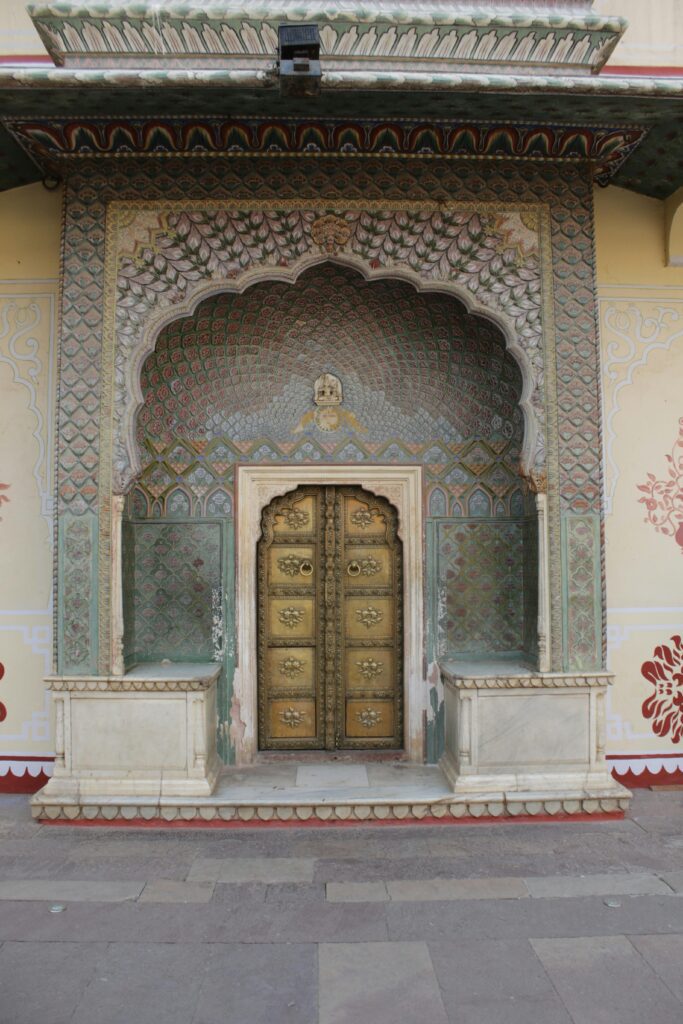
One of the most beautiful courtyards in Jaipur’s City Palace is the Pritam Niwas Chowk.
It is famous for having gates picturing the changing seasons, with each one connected with Hindu gods. Out of all the gates, the Peacock Gate is the most famous one.
It is dedicated to the god Vishnu and represents autumn. The design is intricate, with peacock motifs, flowers, and carvings. It embodies artistry and cultural representation by the use of colors.
The architectural design of Pritam Niwas Chowk showcases the incorporation of aesthetics and spirituality in palace designs.
The city palace gates were not merely aesthetic and were used for ceremonial purposes during particular seasons. The study of traditions of City Palace highlights the incorporation of architectural designs in practices of the city.
As an attraction site, this courtyard is among the most photographed and impressive parts of the City Palace Jaipur and exemplifies artistic genius and meaning.
Courtyards, Gardens, and Space Planning
One of the most striking features of City Palace Jaipur is its effective incorporation of courtyards, gardens, and spatial design, which are essentially the foundation of the architectural design of the palace.
The palace is divided into courtyards, each of which is interlinked, showcasing their functional, ceremonial, as well as aesthetic purposes, developed over the years by royal visionaries.
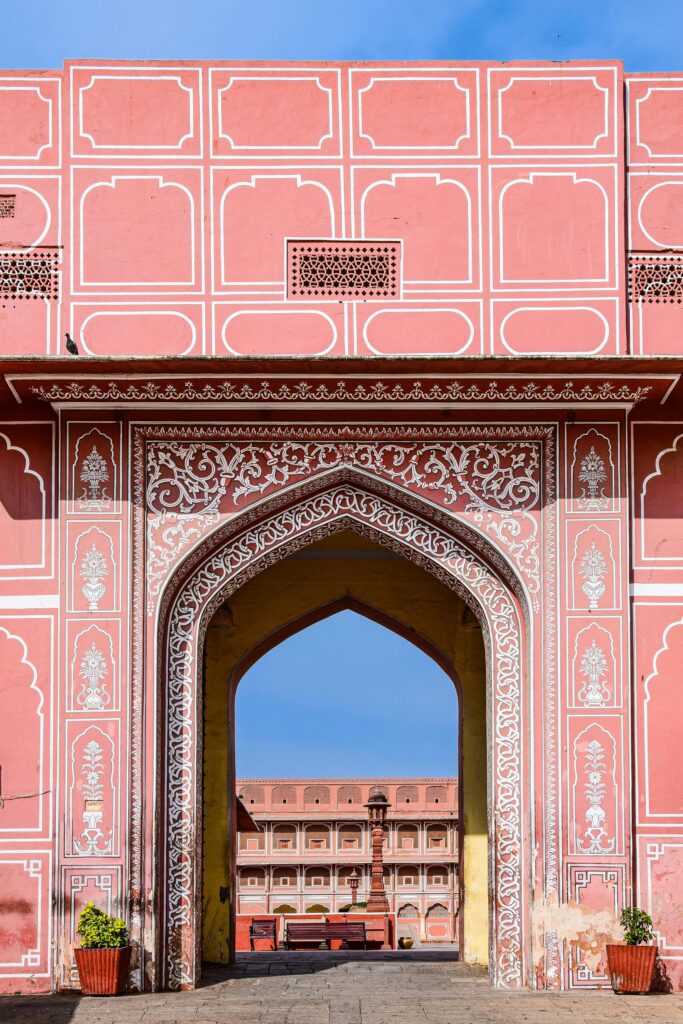
The courtyards in City Palace Jaipur are designed in such a manner that the airflow is controlled and natural lighting is able to reach the palace. This is very vital, given that Jaipur is hot and arid. This is an example of how the needs of the environment and the human race were incorporated during the planning of the palace.
Gardens inside the palace complex add to the beauty of the palace complex itself. The gardens, fountains, and water courses are planned to be a part of the space, with the purpose of relaxation and ceremonies taking place in these gardens.
The gardens not only add to the beauty of the palace complex, which is its purpose, but also serve to cool the area around it, which showcases the climate-sensitive architecture of the City Palace Jaipur itself.
In terms of spatial organization in the palace, there is smooth transition between the private and public zones. This is facilitated by the courtyard, which is a transitional space used to join large ceremonial halls and residential areas while still incorporating the required levels of hierarchy and security.
Gateways, corridors, and open spaces show careful consideration by architects concerning privacy and accessibility.
Alongside their functional purposes, the courtyards and gardens are essential in offering meaning within palace culture.
Every courtyard has its own significance in terms of history or function, with certain places designated for festivals, royal meets, or office work. This layered aspect denotes how architecture was interwoven with Jaipur’s royal family social and cultural life.
Knowledge about the City Palace Jaipur also informs that the inclusion of courtyards and gardens adds value to the experience. This provides an opportunity for the visitors to enjoy the architectural rhythms and symmetry of space and its blend with the surrounding environment while learning about the lifestyle of the ruling dynasties of Jaipur.
In sum, the courtyards and gardens of City Palace Jaipur are not just æsthetic features of the palace but are actually crucial parts of the palace architecture. They are a demonstration of how planning and adaptation can help develop a palace that is functional, grand, and historically rich.
It is because of such harmonious merger that City Palace Jaipur is still one of the most-visited tourist spots and a symbol of exemplary palace architecture.
Art, Paintings, and Decorative Items
Artistic Expression is one of the defining aspects of City Palace Jaipur. Frescoes, murals, mirror work, and other forms of ornate designs are a clear manifestation of royal patronage of arts.
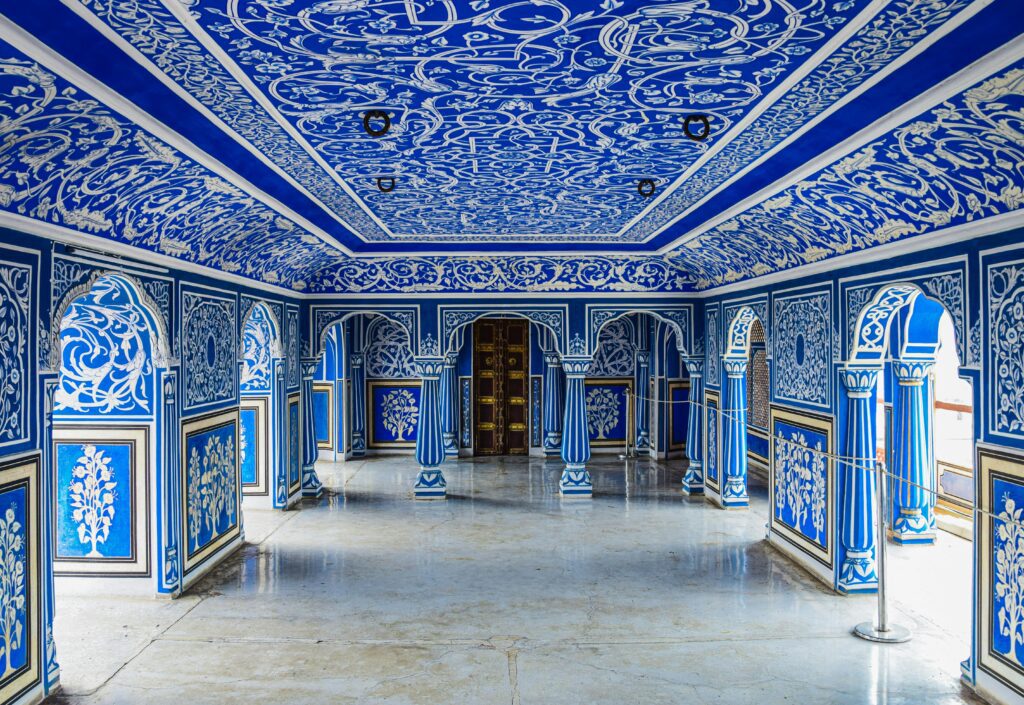
These artistic expressions are a representation of religious motifs, royal life, andhistories.
The architecture of City Palace, Jaipur, is such that it complements artwork with its structural design. The ceilings, doorways, and columns add to a masterpiece by decorating functional areas. The artwork is done by natural colors, signifying expert craftsmanship.
Knowledge of the artwork found in the City Palace gives an indication of the values of the Jaipur rulers’ culture.
These features render the palace not only a dwelling but a center of culture, thus increasing its attractiveness as a tourist site.
City Palace Jaipur as a Cultural and Tourist Site
City Palace Jaipur plays an integral role in Rajasthan’s cultural and tourism sectors. This palace lies in the heart of the old city of Jaipur and thus marks the connection of the old and new Jaipuri culture.
As a tourist site, City Palace Jaipur provides a complete insight into the functioning of the royals of this region over the centuries.
That is why one of the most striking features about the tourist destination of City Palace Jaipur is the presence of a wide variety of tourist attractions in one venue. The museums, courtyards, palaces, and halls at this destination together tend to unfold the story about the rulers of Jaipur.
This is because such venues enable tourists to take a journey through the various sides of the rulers’ lives, which could be politics, arts, and even daily routines.
Preservation of culture is also an important aspect of its continued use. There are exhibits of royal clothing, weapons, manuscripts, and art that give one a glimpse into the life of the ruling family. These exhibits inform one about City Palace not only as an architectural monument but also as a source of culture.
City Palace, Jaipur is also used as a platform for cultural events, rituals, and heritage programs to showcase the artistic heritage of Rajasthan.
This acts as an aid to its status as a cultural organization, rather than a historical monument. The architectural structure of the palace is an authentic setting for such events.
From architectural design, City Palace Jaipur has significantly contributed to its tourist attraction characteristics.
This has been achieved through appropriate design integration involving courtyards, gateways, museums, and residential sections to ensure free flow while maintaining hierarchical levels in maintaining its ancient design.
The accessibility and conservation of City Palace Jaipur make the site even more significant from the perspective of tourism.
The restoration work is aimed at making the palace accessible while retaining its originality. The information and experience-sharing programs increase the knowledge level of the tourists regarding City Palace.
On the whole, the City Palace Jaipur is an iconic cultural symbol that has managed this blend successfully. Its ability to educate and symbolize the royal essence of Jaipur is what makes it such an integral part of Rajasthan’s tourism attractions.
Conservation, Restoration, and Contemporary Relevance
Conservation of the City Palace Jaipur has been an ongoing concern for the royal family and the conservation department. Conservation work aims at preserving the architectural design while ensuring the building’s stability.
Traditional materials and methods have been adopted to maintain the authenticity of this historical monument.
The museums and tourism centers have been planned to have least interference with historical buildings. Thus, City Palace Jaipur is made relevant to the modern world without losing its historical significance.
As a tourist site, the palace is one case study in managing heritage in a sustainable manner.
Importance of the Architecture of the City Palace Jaipur
City Palace Jaipur is a perfect amalgamation of architecture, culture, and historical significance. It has had a large influence on palace designs along the lines of Rajasthan. It symbolizes royal values, artistic genius, and urbanization.
An awareness of City Palace leads to a realization about its significance in creating the identity of Jaipur. The architectural expression of City Palace is a source of wonder and a subject of scholarly research.
Conclusion
Jaipur’s City Palace symbolizes a rich history of Rajasthan, better architecture, and improved culture. A historic landmark in itself, it is a thriving testimonial to effective planning and execution of the vision for Jaipur, one of the best planned royal cities in India.
The palace is a perfect blend of administration, dwelling, art, and culture, making it one of Rajasthan’s most important royal establishments. Knowledge of the City Palace implies that architecture was also employed as an emblem of power and order.
This is because all the planned courtyards, majestic halls, museums, and living quarters not only aimed at aesthetically stunning effect but also at usability and adaptability to various climatic conditions.
This is because every architectural feature at City Palace Jaipur is associated with an uninterrupted architectural history. City Palace, Jaipur, has more to offer as far as its richness of art is concerned.
This also increases its importance. Frescoes, entrance gateways, ceiling paintings, and motifs are proof of the quality of craftsmanship encouraged by the royal family. These works of art were not just to beautify the place; they also had different meanings based on their purpose.
Moreover, since City Palace Jaipur is a tourist site, it provides a first-hand experience of life in and around the palace of a royal family. Museums in the palace are where Jaipur’s former lifestyle is comprehended through the preservation of artifacts, fabrics, and paintings that reflect the lifestyle of the royal families of Jaipur.
However, the royal family resides in some part of the palace, keeping up with the historical continuity of this palace. The restoration and conservation work that has been conducted over the years is significant in that it maintains the structural integrity of the palace and the accuracy of its history.
Through the preservation of the materials and techniques used in the palace, City Palace Jaipur has continued to be an educational resource. This ability to integrate with the current notion of heritage conservation and the ability to relate to the royalty of the palace show its relevance.
Essentially, the City Palace of Jaipur represents the architectural acumen and rich historical significance of the royal era of Jaipur. Its existence and significance as an iconic tourist destination signify the successful maintenance of tradition and architecture on a scale that few other royal structures have achieved within the boundaries of India.