
Introduction:
Reasons Why Jodhpur Should Be Included in Your Travel List
There’s something hypnotic about Jodhpur, the Blue City shimmering in Rajasthan‘s desert light. From afar, its indigo houses spill down from a massive sandstone fort; up close, its alleys hum with life, scent, and colour. Tourists arrive expecting royalty, but the reality is far richer — the places to see in Jodhpur combine living tradition with silent history.
Jodhpur isn’t just a city; it’s an emotion stitched together by legends of Rajput bravery, Mughal artistry, and Rajasthani warmth. Every traveler finds a different rhythm here: some chase fort views, others linger in markets, and many get lost in blue lanes that look like they have been painted by the sky itself.za
Before we reveal the unbelievable places to see in Jodhpur, imagine this: golden sunsets over Mehrangarh Fort, marble cenotaphs aglow in white, street vendors shouting over the clang of metalware, and the aroma of mirchi bada sizzling in oil. These are not tourist clichés but fragments of a city that has mastered the balance between heritage and heart.
This guide lists 11 places to see in Jodhpur, a mix of iconic monuments, local secrets, and hidden corners that most travellers never reach. Whether you are a history buff, photographer, foodie, or wanderer, Jodhpur will surprise you long after you have left it.
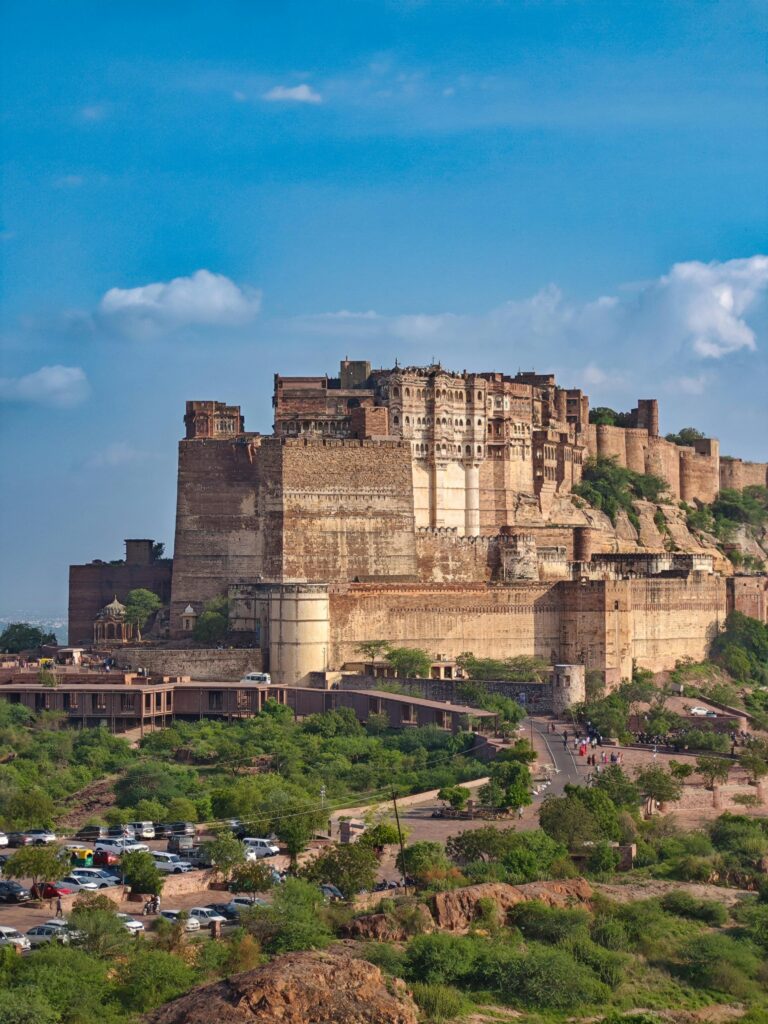
2. Mehrangarh Fort — The Crown Jewel Among All Places to See in Jodhpur
Perched 410 feet above the city, Mehrangarh Fort looms over Jodhpur’s skyline like a silent guardian. It is one of the most imposing places to see in Jodhpur, rising out of rock rather than sitting on it. Built in 1459 by Rao Jodha, this fort isn’t just stone walls; it’s a timeline of Marwar’s power and pride.
Every dent in the iron spikes tells of battles won and sieges survived as you climb its gates — Jai Pol, Fateh Pol, Dedh Kangra Pol. The museum inside houses the palanquins, costumes, and weapons that reveal how lavish and brutal medieval Rajasthan could get.
From the top ramparts, Jodhpur’s famous blue city sprawls beneath you — thousands of houses painted in shades of azure that change with the light. It’s the most photographed view in Rajasthan and one that instantly explains why this fort tops any list of places to see in Jodhpur.
Inside, don’t miss the Sheesh Mahal (Mirror Palace), where candlelight once reflected off a surface of thousands of glass fragments, or the Phool Mahal, a court plated with gold leaf for royal diversion.
Tip: Reach just before sunset. The sky bleeds orange behind the battlements while the blue city below turns indigo, probably one of the most magical moments among all places to see in Jodhpur.
3. Jaswant Thada — the marble wonder of Jodhpur
If Mehrangarh Fort is Jodhpur’s masculine power, Jaswant Thada is its poetic soul. Just a kilometre away, this marble cenotaph stands serene beside a quiet lake. It was built in 1899 by Maharaja Sardar Singh in memory of his father Jaswant Singh II and easily represents one of the most peaceful places to see in Jodhpur.
Wholly cut out of thin slabs of white marble, appearing almost translucent when sunlight filters in, the entire monument shimmers. Walk through its arched halls and one could hear the reverberating echoes of your footsteps-a reminder that this is a resting place of kings. The memorial portraits lining the walls narrate Jodhpur’s lineage in silence.
It’s often overlooked by many travellers after the fort, but that’s a mistake. In its calmness, Jaswant Thada offers a visual and emotional contrast to Mehrangarh’s might. It is also the best vantage point to photograph the fort itself: its red sandstone looming over white marble framed by green gardens.
Of all places to see in Jodhpur, this feels spiritual rather than touristy. Take a moment by the lake; you’ll often spot herons or reflections of marble pillars trembling in the water. Visit early morning when the air is cool, the crowds minimal, and the marble glows gold under the first light.
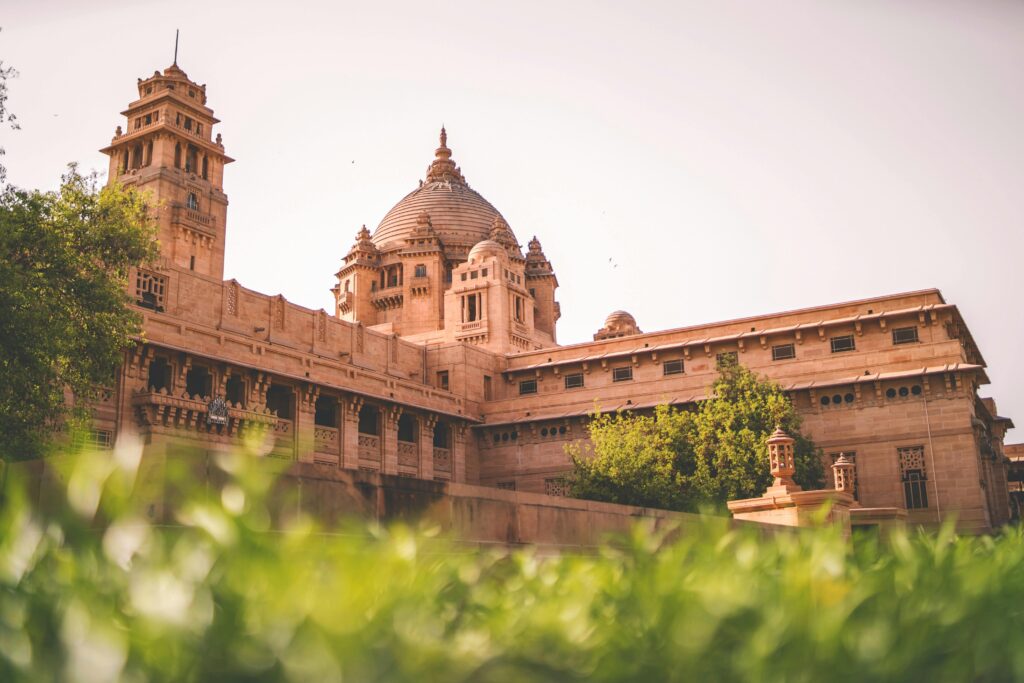
4. Umaid Bhawan Palace – Where Luxury Meets Legacy
When people list luxurious places to see in Jodhpur, nothing surpasses Umaid Bhawan Palace. Completed in 1943 after 15 years of construction, it’s one of the largest private residences in the world — still home to the royal family of Jodhpur.
This palace was commissioned by Maharaja Umaid Singh, where thousands found employment during the famine. Constructed from golden-yellow sandstone, its Art Deco and Indo-Saracenic architecture feels more European than Rajasthani, making it a visual anomaly among other places to see in Jodhpur.
Today, the palace has been divided into three parts: a Taj Heritage Hotel, a royal residence, and a museum showcasing vintage clocks, cars, and regal artefacts. Even if you do not stay here, the museum itself is worth a visit.
It tells stories of the transformation of Jodhpur from a desert kingdom to a modern heritage hub. The lawns are well manicured, the dome is visible from miles around, and at night the palace glows like molten gold under lights. It’s a photographer’s dream and a historian’s delight rolled into one.
If you are curating an itinerary of places to see in Jodhpur that balances opulence with authenticity, Umaid Bhawan Palace sits at that crossroads. Step inside its museum, sip coffee at the café overlooking the lawns, and you will understand why Jodhpur was once-and is still-the land of kings.
5. Clock Tower & Sardar Market: The Vibrant Heart of Local Life
Every city has a pulse, and in Jodhpur, it beats loudest around the Clock Tower and the Sardar Market. Situated right at the center of the city, this bazaar is in equal measures chaos and charm, and a very vivid place to see in Jodhpur if you want to experience local life.
Constructed by Maharaja Sardar Singh more than a century ago, the tall Ghanta Ghar, otherwise known as the Clock Tower, was once, and still is today, the throbbing heart of trade.
Next to it is Sardar Market-a labyrinthine array of over 7,000 very tiny shops spilling over with textiles, spices, handicrafts, jewelry, and antiques.
Colors alone are intoxicating: mounds of red chili, vibrant turbans, silver bangles, blue pottery, and embroidered fabrics stacked high like art installations.
This is where you meet the real Jodhpur — not just the royal but the everyday. Haggling is expected; laughter is guaranteed. The smell of street food — kachoris, mirchi bada, and mawa kachori — wafts between stalls, and it is impossible to leave hungry.
Even for those who aren’t shoppers, a visit to the market is a journey for the senses that tends to showcase just how deeply Jodhpur’s traditions run. No other places to see in Jodhpur match the raw, unfiltered energy here.
Tip: Go late afternoon, when the sun dips and the market lights up. Climb a nearby rooftop café for tea and a sunset view of the Clock Tower glowing against the indigo skyline — the perfect blend of old and new Jodhpur.
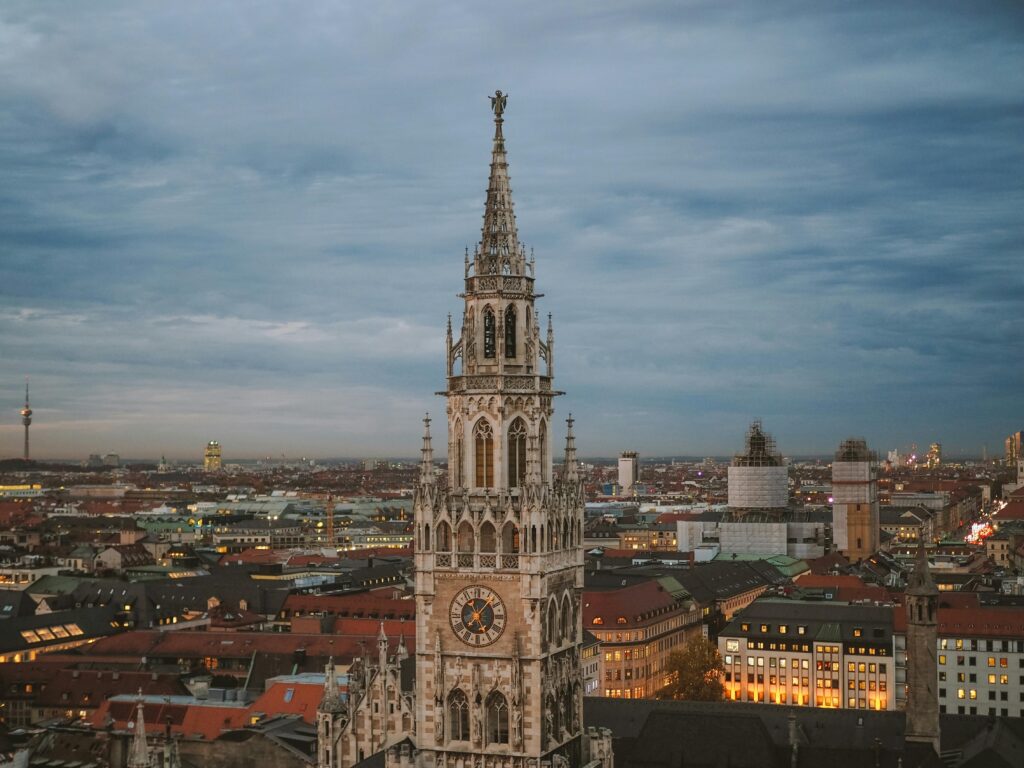
6. Toorji ka Jhalra — The Stepwell You Can’t Miss
Stepwells, or baoris, are some of the engineering marvels of Rajasthan, and Toorji ka Jhalra is one of the most beautiful examples. Tucked away quietly in the old city, this 18th-century structure is among the lesser-known yet most photogenic places to see in Jodhpur.
Commissioned by Queen Toorji, the consort of Maharaja Abhaya Singh, this stepwell once served to give life-giving water to locals. Its intricate sandstone steps cascade 200 feet below ground in perfect geometric symmetry—a design that more often feels like art than architecture.
These days, the stepwell is an oasis in the middle of the city: people come here to spend morning hours, during summer kids jump into the cool water, and photo shooters try to capture the light playing on its descending staircases.
Trendy cafes and boutique hotels have now begun to spring up around it, lending a youthful buzz to the place.
Unlike the crowded forts, Toorji ka Jhalra lets you breathe in silence while soaking in Jodhpur’s ancient soul. It’s these contrasts that make it one of the most unforgettable places to see in Jodhpur: modern energy next to medieval engineering.
For the best photographs, visit at sunrise or before sunset; the low-angle light brings out the symmetry of each step. And if you’re an influencer, know that practically each corner of this stepwell presents an Instagram-worthy shot.
7. Mandore Gardens — Ancient Temples and Cenotaphs Amid Nature
Located ten kilometres north of the city, Mandore Gardens is an open-air museum of Rajasthan’s royal history. Once the capital of Marwar before the foundation of Jodhpur, Mandore still speaks from its crumbling temples and cenotaphs about kings forgotten by time.
For history buffs, this is one of the most underrated places to See in Jodhpur.
Cenotaphs (chhatris) dot the gardens, each dedicated to a former ruler. A fine combination of Hindu and Mughal architectural styles forms these.
The red sandstone pillars, carved arches, and domed pavilions stand in serene contrast to the green lawns and blooming trees. Among them, the cenotaph of Maharaja Ajit Singh is the most striking, as it is a tall structure with intricate carvings.
Walk further into the complex and one will come to the Hall of Heroes with statues of local deities and warriors carved out of rock. Next to it is the Temple of 33 Crore Gods, an astonishing collection of colored Hindu idols representing divine abundance.
Unlike most touristy places to see in Jodhpur, Mandore Gardens are never too crowded. You can sit under a tree, listen to the peacocks calling, and imagine how life once unfolded here centuries ago.
The place is best visited during the early morning or late afternoon when the heat lessens. Bring water, wear comfortable shoes, and take it easy because Mandore rewards those who tread slowly. For a tranquil, history-soaked afternoon, there’s no better escape inside or outside Jodhpur’s city limits.
8. Rao Jodha Desert Rock Park is a natural getaway next to the fort.
Right next to the mighty Mehrangarh Fort lies a completely different world: the Rao Jodha Desert Rock Park, one of the most unique places to see in Jodhpur. Spread over 70 hectares, it was created in 2006 to restore the natural ecology of the rocky wasteland that once surrounded the fort.
Today, it’s a living museum of desert flora and geology, showcasing over 80 species of native plants. The park trails wind through volcanic rock formations and offer surreal views of Mehrangarh towering above.
The silence here feels almost sacred; only the wind and the rustle of dry leaves accompany you.
For the traveling visitor in search of nature among heritage, this park comes as a revelation that proves the point: Jodhpur is not all about palaces built by royalties; it is about resilience, human and natural.
Trails for walking are well-marked, from an easy 20-minute walk to 90-minute treks. Interpretive boards explain the plants, rocks, and the efforts at restoration.
Walking, you notice how the colors of the park change at different times of the day-gold at dawn, ochre by noon, crimson at sunset. It’s a photographer’s paradise and a meditative space rolled into one. Among the places to see in Jodhpur, few match its balance of peace, science, and scenery.
Tip: Go early morning for cooler temperatures, wear comfortable shoes, and carry water. End your visit at the park café where you can sip lemonade while looking up towards the fort — a perfect reminder that even the harshest landscapes can bloom again.
9. Kailana Lake — Serene Getaway from the Bustling City Sounds
After visiting forts and markets in Places to See in Jodhpur, every traveler needs a pause — a quiet moment to breathe. Kailana Lake offers just that. Situated about 8 km from the city center, this artificial lake was constructed in 1872 by Pratap Singh, serving both as a water source and a retreat for royals.
Today, it is counted among the most tranquil places to see in Jodhpur, fitting well into the list for a sunset watcher or a nature lover.
Kailana Lake, unlike most historical monuments that dominate the ‘places to see in Jodhpur’ list, speaks volumes of simplicity: open skies, gentle ripples, and an occasional flock of migratory birds gliding across the water.
Boating during sunsets here feels just as great as going through the screens; the golden sun slipping into the horizon, and the lights of this city flickering at a distance.
It’s also a favorite with photographers: reflections of the setting sun, silhouettes of boats, and the peaceful expanse of water offer breathtaking compositions. Couples and families frequent the spot for evening picnics or to take in a quiet boat ride.
For those who have had their fill of forts and crowds, Kailana Lake provides balance-nature’s reminder that Jodhpur’s beauty isn’t just in the stone it’s built from but also in reflected still water. Add it to your list of places to see in Jodhpur if you crave quiet moments after the city’s energy overwhelms you.
Tip: Go around 5 p.m. for the best light and views. You can enjoy tea or snacks at the stalls nearby while taking in the breeze of the desert.
10. Chamunda Mata Temple — Spiritual Serenity with a View
Perched within the ramparts of Mehrangarh Fort, the Chamunda Mata Temple is one of the most sacred places to see in Jodhpur, combining faith and breathtaking views.
This temple, devoted to Goddess Chamunda Devi, holds a very special place in the hearts of the locals, especially for the royal family of Jodhpur, as the goddess is considered their patron deity.
The story goes that Rao Jodha, the founder of Jodhpur, brought the idol of Chamunda Devi from the old Mandore fort to this location in 1460. Since then, the goddess has been worshiped as the protector of the city.
Every year during Dussehra, thousands of devotees climb up the fort to seek her blessings, transforming the usually silent fort into a place of thunderous devotion.
Even if you are not religious, the temple provides a view that is simply incomparable. From this point, the city unfolds like a sea of blue, making it one of the most rewarding places to see in Jodhpur.
The juxtaposition of faith and fortification, of ancient stone and endless sky, lends this spot a rare spiritual energy.
The temple courtyard is small but powerful; incense smoke curls into the wind, bells echo, and the hum of prayers mingles with the sound of ravens circling the battlements. To experience Jodhpur’s soul rather than its sights, head to Chamunda Mata Temple.
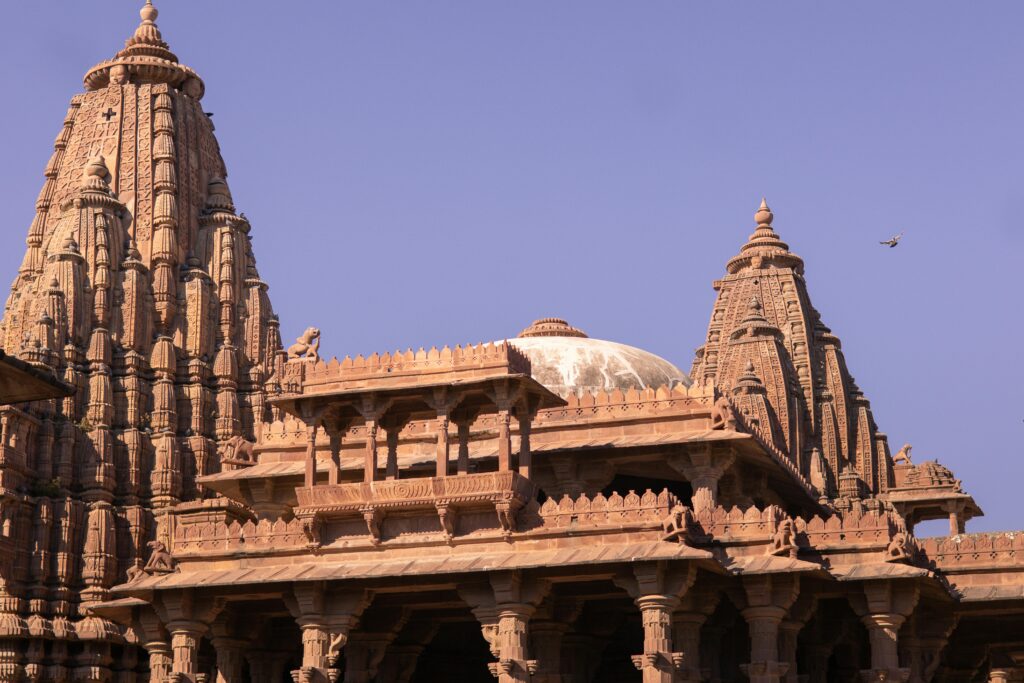
11. Bishnoi Village: Discover the Real Culture of Rural Rajasthan
While most tourists confine themselves to the grandeur of the city, the real charm of Jodhpur extends into its villages, and Bishnoi Village is just the perfect window into rural Rajasthan.
Lying about 22 km away, it is amongst the most culturally rich places to see in Jodhpur, where simplicity, tradition, and sustainability coexist in a perfect balance.
The Bishnoi community is famous for its eco-friendly lifestyle. Long before “sustainability” became a global buzzword, the Bishnois were practicing it day in and day out — protecting trees, animals, and nature as part of their religion. Their devotion to wildlife, especially the blackbuck antelope, is legendary.
A visit here is tantamount to living in a museum. One would notice women spinning on traditional looms, men crafting pottery, or artisans involved in intricate block prints or leatherwork. Most houses welcome visitors with local chai and demonstrate their skill.
You can also experience the opium ceremony, which is performed as a part of culture rather than for recreational reasons, and take part in a camel ride through the sand.
Bishnoi Village is the kind of authenticity that polished tourist spots cannot genuinely offer. It’s raw, real, and totally human, serving as a reminder to travelers that the heart of Rajasthan continues to beat in its villages. Among all the places to see in Jodhpur, this one offers the richest cultural immersion.
Insider’s tip: Go with a local guide who can help explain the traditions and ensure your visit is directly supporting the local artisans.
12. Bonus Hidden Spots – Secret Alleys and Blue Houses of the Old City
Fact is, beyond forts and palaces, the real charm of Jodhpur stands in its maze of old city lanes painted blue. Narrow and serpentine, these are probably the most photogenic and highly overlooked places to see in Jodhpur. There are no ticket counters or signboards here, but you will find something even better: authenticity.
Stroll through Navchokiya or Brahmpuri – the areas that enthrall with their blue-colored walls. The locals will tell you how the blue paint keeps the houses cool and protects them from termites, but as tourists know, it’s something beyond that-it’s Jodhpur’s identity.
Every turn reveals a new composition: old wooden doors, carved windows, painted walls, and children playing cricket in the streets.
These alleys are a paradise for photographers and storytellers alike. Light reflects off from the blue surfaces, creating an otherworldly glow: soft and dreamy, surreal. Along the way, you will find locals who will greet you with a smile, ready to tell you stories or pose in your picture.
If you are tired of structured sightseeing, come here to aimlessly wander. Follow the sound of temple bells, smell of incense, or laughter of kids, and you just might find these streets have more soul than most monuments.
For those who really want to experience the heartbeat of this city, these blue alleys are among the most rewarding places to see in Jodhpur.
Tip: Early morning is the best time to explore before the crowds wake up and the light is perfect for photos.
13. Conclusion —
Why These Are the Most Unbelievable Places to See in Jodhpur Jodhpur is not merely another dot on a tourist map; it’s a story chiseled in stone, painted in blue, and sung through desert winds.
From the grand rise of Mehrangarh Fort, skirting the quiet steps of Toorji ka Jhalra, the royal opulence of Umaid Bhawan Palace, to the rustic simplicity of Bishnoi Village-every nook tells a different tale of Rajasthan’s timeless spirit.
The places to see in Jodhpur are not about architecture or history alone but about atmosphere-the feeling of standing on a fort terrace and watching the city glow or losing yourself in the blue alleys smelling of spice and dust.
Every place, from the grand to the humble, has something to teach about endurance, artistry, and beauty born from harsh landscapes. If you ever doubted that a city could be both royal and raw, Jodhpur will change your mind.
Its magic lies in the contrast — chaos and calm, gold and blue, tradition and modernity — all at play in perfect balance. That’s why travelers who come here rarely leave unchanged.
So, don’t wait until it is “too late.” Pack your bags, charge your camera, and let these unbelievable places to see in Jodhpur remind you why India’s heritage cities still hold the power to astonish. The Blue City is waiting-and it is ready to make you fall in love with history all over again.